Adipotide
Research description
Adipotide is a synthetic peptide of 25 residues: the sequence CKGGRAKDC joined through a two-glycine linker to the D-amino-acid repeat (KLAKLAK)2. PubChem CID 163360068, formula C111H206N36O28S2. For research use only.
Unit price
$74.00
Quantity
Buy more, save more
| Pack | Unit price | Total | Saved |
|---|
- Third-party COA on file Certificate published for every released lot.
- Purity guarantee Independently assay any lot. Below certificate, we refund or replace.
Research use only
For laboratory research use only. Not for human or veterinary use. Not a drug, supplement, food, or cosmetic. Product descriptions summarise published laboratory literature and are not a recommendation for any use in humans or animals.
Adipotide / Description
Material identity
Adipotide is a synthetic peptide of 25 residues, listed as a research material. Its sequence joins the cysteine-flanked motif CKGGRAKDC to the repeat (KLAKLAK)2 through a two-glycine linker, and the last 14 residues are D-amino acids. The sequence was named adipotide in Sci Transl Med in 2011, building on the CKGGRAKDC motif reported in Nat Med in 2004. This page lists the identifiers shown in its PubChem record.
| Name | Adipotide |
|---|---|
| Research class | Synthetic peptide |
| Molecular formula | C111H206N36O28S2 |
| Molecular weight | 2557.2 g/mol (free peptide) |
| Monoisotopic mass | 2555.5244 Da |
| Exact mass | 2556.5277 Da |
| PubChem CID | 163360068 |
| InChIKey | GZESIPHLGJDZRG-VCWDIOOSSA-N |
| Sequence | CKGGRAKDC-GG-D(KLAKLAK)2, written out as CKGGRAKDCGGKLAKLAKKLAKLAKPositions 12 to 25 are D-amino acids. The N-terminus is a free amine and the C-terminus is a free acid. Both cysteine thiols (positions 1 and 9) are free. |
| Three-letter sequence | H-Cys-Lys-Gly-Gly-Arg-Ala-Lys-Asp-Cys-Gly-Gly-D-Lys-D-Leu-D-Ala-D-Lys-D-Leu-D-Ala-D-Lys-D-Lys-D-Leu-D-Ala-D-Lys-D-Leu-D-Ala-D-Lys-OH |
| Residue count | 25 |
| Composition | Lys 8, Ala 5, Gly 4, Leu 4, Cys 2, Arg 1, Asp 1 |
| N-terminus and C-terminus | H- (free amine) and -OH (free acid) |
| Chirality | 21 defined stereocentres: 7 in L-residues (positions 1, 2, 5, 6, 7, 8, 9) and 14 in D-residues (positions 12 to 25). Glycine has none. |
| NLM MeSH concept | C576018, entry term adipotide, registry number 0 |
Computed descriptors
| Heavy atom count | 177 |
|---|---|
| Hydrogen bond donors | 40 |
| Hydrogen bond acceptors | 40 |
| Rotatable bonds | 98 |
| Polar surface area (topological) | 1070 Ų |
| XLogP3-AA | -11.4 |
| Complexity | 5220 |
| Chiral atoms (defined, undefined) | 21 and 0 |
| Chiral bonds (defined, undefined) | 0 and 0 |
| Covalently bonded units | 1 |
| Formal charge | 0 |
Line notations
Show SMILES, InChI, HELM, PLN and IUPAC name
| SMILES | C[C@@H](C(=O)N[C@@H](CCCCN)C(=O)N[C@@H](CC(=O)O)C(=O)N[C@@H](CS)C(=O)NCC(=O)NCC(=O)N[C@H](CCCCN)C(=O)N[C@H](CC(C)C)C(=O)N[C@H](C)C(=O)N[C@H](CCCCN)C(=O)N[C@H](CC(C)C)C(=O)N[C@H](C)C(=O)N[C@H](CCCCN)C(=O)N[C@H](CCCCN)C(=O)N[C@H](CC(C)C)C(=O)N[C@H](C)C(=O)N[C@H](CCCCN)C(=O)N[C@H](CC(C)C)C(=O)N[C@H](C)C(=O)N[C@H](CCCCN)C(=O)O)NC(=O)[C@H](CCCNC(=N)N)NC(=O)CNC(=O)CNC(=O)[C@H](CCCCN)NC(=O)[C@H](CS)N |
|---|---|
| InChI | InChI=1S/C111H206N36O28S2/c1-60(2)49-79(142-99(163)71(32-15-23-41-113)133-87(150)56-125-86(149)55-127-97(161)84(59-177)147-109(173)83(53-89(152)153)146-103(167)76(36-19-27-45-117)138-90(154)64(9)128-98(162)72(39-30-48-123-111(121)122)134-88(151)57-124-85(148)54-126-96(160)70(31-14-22-40-112)139-95(159)69(120)58-176)105(169)129-66(11)92(156)136-74(34-17-25-43-115)101(165)143-80(50-61(3)4)106(170)130-65(10)91(155)135-73(33-16-24-42-114)100(164)140-77(37-20-28-46-118)104(168)145-82(52-63(7)8)107(171)131-67(12)93(157)137-75(35-18-26-44-116)102(166)144-81(51-62(5)6)108(172)132-68(13)94(158)141-78(110(174)175)38-21-29-47-119/h60-84,176-177H,14-59,112-120H2,1-13H3,(H,124,148)(H,125,149)(H,126,160)(H,127,161)(H,128,162)(H,129,169)(H,130,170)(H,131,171)(H,132,172)(H,133,150)(H,134,151)(H,135,155)(H,136,156)(H,137,157)(H,138,154)(H,139,159)(H,140,164)(H,141,158)(H,142,163)(H,143,165)(H,144,166)(H,145,168)(H,146,167)(H,147,173)(H,152,153)(H,174,175)(H4,121,122,123)/t64-,65+,66+,67+,68+,69-,70-,71+,72-,73+,74+,75+,76-,77+,78+,79+,80+,81+,82+,83-,84-/m0/s1 |
| HELM | PEPTIDE1{C.K.G.G.R.A.K.D.C.G.G.[dK].[dL].[dA].[dK].[dL].[dA].[dK].[dK].[dL].[dA].[dK].[dL].[dA].[dK]}$$$$ |
| PLN | H-CKGGRAKDCGG{d}K{d}L{d}A{d}K{d}L{d}A{d}K{d}K{d}L{d}A{d}K{d}L{d}A{d}K-OH |
| IUPAC name | (2R)-6-amino-2-[[(2R)-2-[[(2R)-2-[[(2R)-6-amino-2-[[(2R)-2-[[(2R)-2-[[(2R)-6-amino-2-[[(2R)-6-amino-2-[[(2R)-2-[[(2R)-2-[[(2R)-6-amino-2-[[(2R)-2-[[(2R)-2-[[(2R)-6-amino-2-[[2-[[2-[[(2R)-2-[[(2S)-2-[[(2S)-6-amino-2-[[(2S)-2-[[(2S)-2-[[2-[[2-[[(2S)-6-amino-2-[[(2R)-2-amino-3-sulfanylpropanoyl]amino]hexanoyl]amino]acetyl]amino]acetyl]amino]-5-carbamimidamidopentanoyl]amino]propanoyl]amino]hexanoyl]amino]-3-carboxypropanoyl]amino]-3-sulfanylpropanoyl]amino]acetyl]amino]acetyl]amino]hexanoyl]amino]-4-methylpentanoyl]amino]propanoyl]amino]hexanoyl]amino]-4-methylpentanoyl]amino]propanoyl]amino]hexanoyl]amino]hexanoyl]amino]-4-methylpentanoyl]amino]propanoyl]amino]hexanoyl]amino]-4-methylpentanoyl]amino]propanoyl]amino]hexanoic acid |
| Residue names | L-cysteinyl-L-lysyl-glycyl-glycyl-L-arginyl-L-alanyl-L-lysyl-L-alpha-aspartyl-L-cysteinyl-glycyl-glycyl-D-lysyl-D-leucyl-D-alanyl-D-lysyl-D-leucyl-D-alanyl-D-lysyl-D-lysyl-D-leucyl-D-alanyl-D-lysyl-D-leucyl-D-alanyl-D-lysine |
Chemical structure
Structure depiction of adipotide from PubChem, CID 163360068
Frequently asked questions
What is adipotide?
Adipotide is a synthetic peptide of 25 residues. PubChem lists it as CID 163360068 with the formula C111H206N36O28S2. It is listed as a laboratory research material.
How is the chain built?
It starts with H-Cys-Lys-Gly-Gly-Arg-Ala-Lys-Asp-Cys, continues through a two-glycine linker and ends with the 14-residue repeat KLAKLAKKLAKLAK in D-form. The N-terminus is a free amine and the C-terminus is a free acid.
What do the residue count and sequence tell us?
The chain has 25 residues: 8 lysine, 5 alanine, 4 glycine, 4 leucine, 2 cysteine, 1 arginine and 1 aspartic acid. The cysteines sit at positions 1 and 9, and the D-form repeat runs from position 12 to 25.
Which non-standard or modified residues does it contain?
None are modified. Positions 12 to 25 are D-lysine (6), D-leucine (4) and D-alanine (4), the mirror-image forms of the common amino acids, so the repeat is written D-(KLAKLAK)2.
What does a terminal group such as H- or -OH mean?
H- at the start means the N-terminal amino group is free. -OH at the end means the C-terminus is a free carboxylic acid (-COOH) and not an amide (-NH2).
Do the identifiers describe the free peptide or a salt?
They describe the free peptide as computed by PubChem: C111H206N36O28S2, 2557.2 g/mol and monoisotopic mass 2555.5244 Da, with both cysteine thiols free. One acetic acid per peptide would give C113H210N36O30S2 and about 2617.3 g/mol.
Which database identifiers belong to this compound?
PubChem CID 163360068 and the InChIKey GZESIPHLGJDZRG-VCWDIOOSSA-N, both from the PubChem record. The NLM MeSH record C576018 has the entry term adipotide and registry number 0.
When was it first described?
The CKGGRAKDC motif was reported by Kolonin et al., Nat Med 2004 (PMID 15133506). The full sequence was named adipotide by Barnhart et al., Sci Transl Med 2011 (PMID 22072637).
Which structural feature is specific to this compound?
Two free cysteine thiols at positions 1 and 9 sit with a 14-residue repeat written entirely in D-form. PubChem defines all 21 stereocentres, 7 L and 14 D, and glycine has none.
What does research use only mean?
It means the material is supplied only for laboratory research. It is not for human or animal use or for diagnostic procedures. The buyer is responsible for handling and using the material in line with applicable laws.
References
- Kolonin MG, Saha PK, Chan L, Pasqualini R, Arap W. Nat Med. 2004;10(6):625-632. doi:10.1038/nm1048. PubMed 15133506
- Barnhart KF, Christianson DR, Hanley PW, et al. Sci Transl Med. 2011;3(108):108ra112. doi:10.1126/scitranslmed.3002621. PubMed 22072637
- Hossen N, Kajimoto K, Akita H, Hyodo M, Harashima H. J Control Release. 2013;171(2):104-112. doi:10.1016/j.jconrel.2013.07.013. PubMed 23871959
- Chung JY, Ain QU, Song Y, Yong SB, Kim YH. Genome Res. 2019;29(9):1442-1452. doi:10.1101/gr.246900.118. PubMed 31467027
- Chan LY, Weger BD, Weger M, et al. J Am Chem Soc. 2025;147(28):24628-24642. doi:10.1021/jacs.5c05536. PubMed 40591817
- Cho Y, Kim HG, Oh ET. Biomolecules. 2026;16(1):74. doi:10.3390/biom16010074. PubMed 41594614
- PubChem compound record, Adipotide, CID 163360068. PubChem
- NLM MeSH record C576018, CKGGRAKDC-GG-D(KLAKLAK)2. MeSH record
For Research Use Only. Not for human or animal use. Not for use in diagnostic procedures.
Every lot released under this product line, newest first. The lot number printed on your vial label resolves to the certificate below — purity, net content, endotoxin, appearance and the number of vials pulled for the conformity panel.
No lots have been published for this product yet.
- Research class
- Synthetic peptide
- Sequence
- CKGGRAKDC-GG-D(KLAKLAK)2, written out as CKGGRAKDCGGKLAKLAKKLAKLAK. The last 14 residues, positions 12 to 25, are D-amino acids. The N-terminus is a free amine and the C-terminus is a free acid.
- Molecular formula
- C111H206N36O28S2
- Molecular weight
- 2557.2 g/mol
- CAS number
- 859216-15-2
Handling notes
Reconstitution figures for any fill weight and diluent volume can be worked out on the concentration calculator. Solubility and storage data on this page describe laboratory handling of the material only.
This compound is not light-sensitive under normal laboratory lighting. Standard clear containers are acceptable for reconstituted stock.
Sealed storage
- Temperature
- Shelf life
After reconstitution
- Temperature
- Working window
- Light sensitive
- No
In transit
- Note
- Free shipping
- US orders over $200
Related
Studied alongside this compound
-
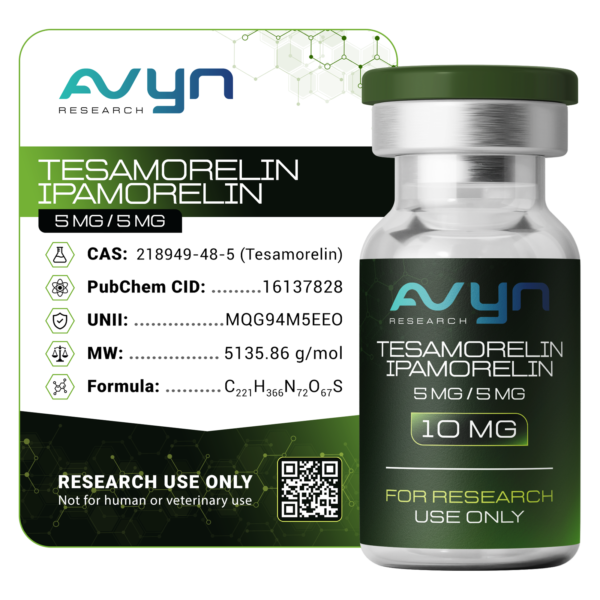
Tesamorelin/Ipamorelin
Tesamorelin and ipamorelin, two separate synthetic peptides supplied for laboratory research. Tesamorelin is a 44-residue analogue of human growth hormone-releasing factor (CAS 218949-48-5). Ipamorelin is a synthetic pentapeptide (CAS 170851-70-4). For research use only.
Add 10mg -
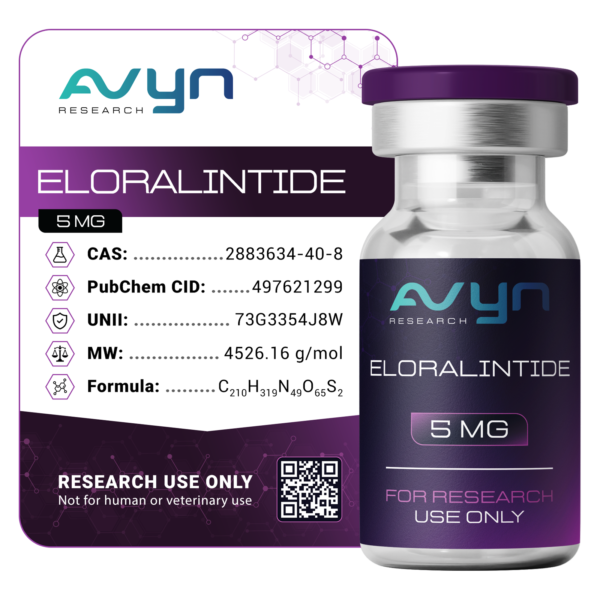
Eloralintide
Eloralintide (LY3841136) is a synthetic 37-residue peptide, listed by the WHO as an amylin analogue, supplied for laboratory research (CAS 2883634-40-8). For research use only.
Add 5mg -
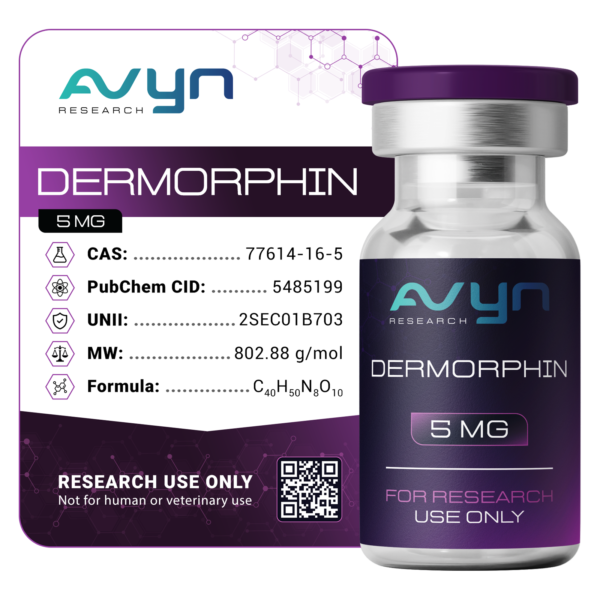
Dermorphin
Dermorphin is a seven-residue opioid peptide with D-alanine at position 2 and an amidated C-terminus.
Add 5mg -