Eloralintide
Research description
Eloralintide (LY3841136) is a synthetic 37-residue peptide, listed by the WHO as an amylin analogue, supplied for laboratory research (CAS 2883634-40-8). For research use only.
Unit price
From $110.00
Quantity
Buy more, save more
| Pack | Unit price | Total | Saved |
|---|
- Third-party COA on file Certificate published for every released lot.
- Purity guarantee Independently assay any lot. Below certificate, we refund or replace.
Research use only
For laboratory research use only. Not for human or veterinary use. Not a drug, supplement, food, or cosmetic. Product descriptions summarise published laboratory literature and are not a recommendation for any use in humans or animals.
Eloralintide / Description
Material identity
Eloralintide is a synthetic peptide of 37 residues, listed by the WHO as an amylin analogue. A methylene thioacetal bridge joins Cys2 and Cys7, and a C20 fatty diacid is attached at Lys26 through two γ-glutamyl residues. The structure was described by Eli Lilly and Company researchers in Molecular Metabolism in 2025. CAS 2883634-40-8. Listed as a research material.
| Name | Eloralintide |
|---|---|
| Research class | Synthetic peptide |
| Molecular formula | C201H319N49O65S2 |
| Molecular weight | 4526 g/mol (free peptide) |
| Development code | LY3841136 |
| ChEMBL ID | CHEMBL6068462 |
| Sequence | γ-Glu–Cys–Asn–Thr–Ala–Thr–Cys–Ala–Thr–Gly–Orn–Leu–Ala–Glu–α-MePhe–Leu–Val–Arg–Ser–Ser–Asn–N²-MeAsn–Phe–Gly–Pro–Lys–Leu–Pro–Pro–Thr–Glu–Val–Gly–Ser–Asn–Thr–Tyr–NH₂Cys2 and Cys7 are joined by a methylene bridge. Lys26 carries a C20 diacid through two γ-glutamyl residues. The C-terminus is an amide. WHO Proposed INN List 131, p. 323 |
| UNII | 73G3354J8W |
Chemical structure
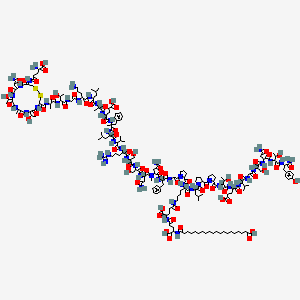
Structure depiction of eloralintide from PubChem, CID 175663130
Frequently asked questions
What is eloralintide?
A synthetic peptide of 37 residues that the WHO lists as an amylin analogue (INN Proposed List 131). Its CAS number is 2883634-40-8.
How is the chain built?
The chain starts with a γ-glutamyl residue and ends in tyrosine amide. Cys2 and Cys7 are joined by a methylene bridge, and Lys26 carries the fatty diacid.
What do the residue count and sequence tell us?
The chain has 37 residues, the same length as native human amylin. Lys26 is the acylated position, and the non-coded residues sit at positions 11, 15 and 22 (Briere et al., PMID 41109426).
Which non-standard or modified residues does it contain?
Ornithine (Orn) at position 11, α-methylphenylalanine (α-MePhe) at position 15 and N-methylasparagine (N-MeAsn) at position 22. Ornithine is an amino acid that DNA does not code for, α-MePhe carries an extra methyl group on the α-carbon, and N-MeAsn carries a methyl group on the amide nitrogen.
What does the terminal group -NH₂ mean?
It means the C-terminal carboxyl group is an amide (-CONH₂) instead of a free acid (-COOH).
Do the identifiers describe the free peptide or a salt?
They describe the free peptide as computed by PubChem: formula C201H319N49O65S2, molecular weight 4526 g/mol, exact mass 4525.2671 Da and monoisotopic mass 4523.2604 Da. A salt form is stated only from the lot COA.
Which database identifiers belong to this compound?
CAS 2883634-40-8 (WHO INN Proposed List 131, p. 323), PubChem CID 175663130, UNII 73G3354J8W and NCI Thesaurus code C206906 (substance registry), ChEMBL CHEMBL6068462 and development code LY3841136. PubChem lists 0 defined and 41 undefined atom stereocentres, so the InChIKey RLBIFQNAUXZCQB-UHFFFAOYSA-N ends in UHFFFAOYSA-N. A check that expects a stereo-specific key will not match, so match on formula and mass instead.
Where is the structure described?
Eli Lilly and Company researchers described the structure in Briere et al., Molecular Metabolism 2025;102:102271 (PMID 41109426). WHO proposed the name in INN Proposed List 131 (August 2024).
Which structural features are specific to this compound?
A methylene thioacetal bridge (-S-CH₂-S-) links Cys2 and Cys7 in place of the disulfide found in native amylin, and a C20 fatty diacid is attached to Lys26 through two γ-glutamyl residues.
What does research use only mean?
It means the material is supplied only for laboratory research. It is not for human or animal use or for diagnostic procedures. The buyer is responsible for handling and using the material in line with applicable laws.
References
- Briere DA, et al. Mol Metab. 2025;102:102271. doi:10.1016/j.molmet.2025.102271 · PubMed 41109426
- World Health Organization. International Nonproprietary Names, Proposed List 131, p. 323 (eloralintidum). WHO record
- FDA Global Substance Registration System, UNII 73G3354J8W. Registry record
- PubChem compound record, CID 175663130. PubChem
- ChEMBL compound record CHEMBL6068462. ChEMBL
For Research Use Only. Not for human or animal use. Not for use in diagnostic procedures.
Every lot released under this product line, newest first. The lot number printed on your vial label resolves to the certificate below — purity, net content, endotoxin, appearance and the number of vials pulled for the conformity panel.
No lots have been published for this product yet.
- Research class
- Synthetic peptide (amylin analogue)
- Sequence
- γ-Glu–Cys–Asn–Thr–Ala–Thr–Cys–Ala–Thr–Gly–Orn–Leu–Ala–Glu–α-MePhe–Leu–Val–Arg–Ser–Ser–Asn–N²-MeAsn–Phe–Gly–Pro–Lys–Leu–Pro–Pro–Thr–Glu–Val–Gly–Ser–Asn–Thr–Tyr–NH₂
- Molecular formula
- C201H319N49O65S2
- Molecular weight
- 4526
- CAS number
- 2883634-40-8
Handling notes
Reconstitution figures for any fill weight and diluent volume can be worked out on the concentration calculator. Solubility and storage data on this page describe laboratory handling of the material only.
This compound is not light-sensitive under normal laboratory lighting. Standard clear containers are acceptable for reconstituted stock.
Sealed storage
- Temperature
- Shelf life
After reconstitution
- Temperature
- Working window
- Light sensitive
- No
In transit
- Note
- Free shipping
- US orders over $200
Related
Studied alongside this compound
-
Tesamorelin/Ipamorelin
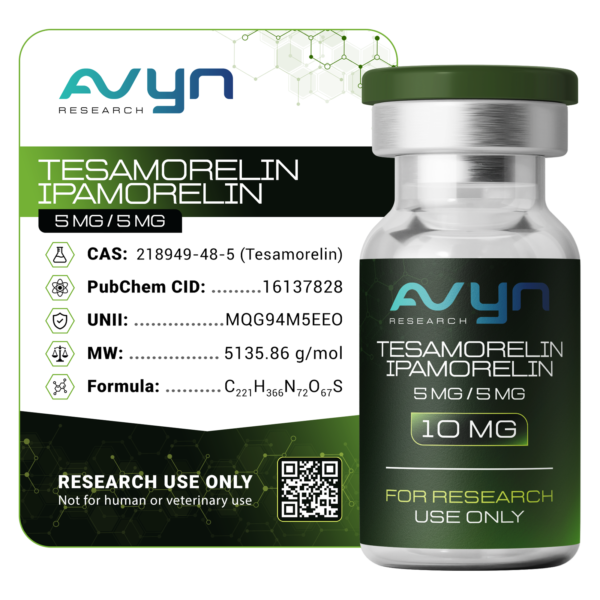
Tesamorelin and ipamorelin, two separate synthetic peptides supplied for laboratory research. Tesamorelin is a 44-residue analogue of human growth hormone-releasing factor (CAS 218949-48-5). Ipamorelin is a synthetic pentapeptide (CAS 170851-70-4). For research use only.
Add 10mg -
-
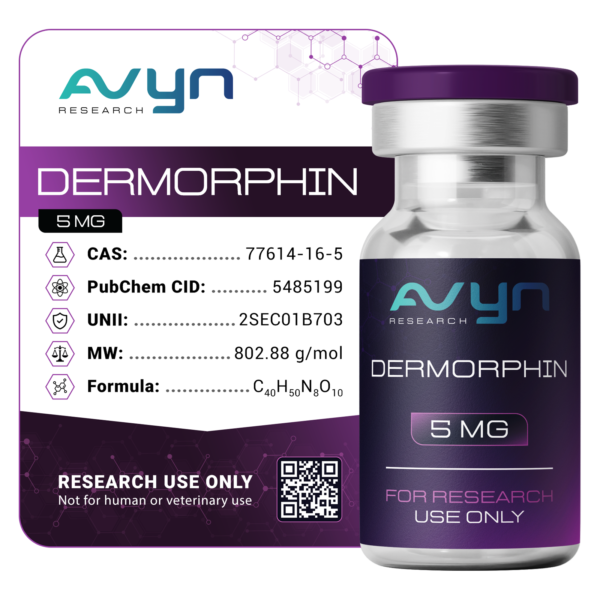
Dermorphin
Dermorphin is a seven-residue opioid peptide with D-alanine at position 2 and an amidated C-terminus.
Add 5mg -