GLP-1-S/BPC-157
Research description
A two-component peptide research mixture containing GLP-1-S and BPC-157, supplied as a lyophilised laboratory material. Each lot ships with a certificate of analysis reporting identity by mass spectrometry and purity by HPLC. For Research Use Only.
Unit price
$123.00
Quantity
Buy more, save more
| Pack | Unit price | Total | Saved |
|---|
- Third-party COA on file Certificate published for every released lot.
- Purity guarantee Independently assay any lot. Below certificate, we refund or replace.
Research use only
For laboratory research use only. Not for human or veterinary use. Not a drug, supplement, food, or cosmetic. Product descriptions summarise published laboratory literature and are not a recommendation for any use in humans or animals.
GLP-1-S/BPC-157 / Description
Material identity
This product contains a defined two-peptide mixture, supplied as a lyophilised solid for qualified laboratory investigators. It is intended for analytical method development, chromatographic separation studies, mass-spectrometric identity work and other in vitro research applications. It is not a medicine, has not been evaluated by any regulatory authority, and is not intended for any human or animal use.
| Name | GLP-1-S | BPC-157 |
|---|---|---|
| Research class | Acylated GLP-1 peptide analogue | Synthetic linear pentadecapeptide |
| Molecular formula | C187H291N45O59 | C62H98N16O22 |
| Molecular weight | 4113.6 g/mol | 1419.6 g/mol |
| Development code | NN-9535 | PL-14736 |
| ChEMBL ID | CHEMBL2108724 | CHEMBL4297358 |
| Sequence | His–Aib–Glu–Gly–Thr–Phe–Thr–Ser–Asp–Val–Ser–Ser–Tyr–Leu–Glu–Gly–Gln–Ala–Ala–Lys–Glu–Phe–Ile–Ala–Trp–Leu–Val–Arg–Gly–Arg–Gly. Lys26 (GLP-1 numbering) carries a linker-attached C18 fatty diacid. | Gly–Glu–Pro–Pro–Pro–Gly–Lys–Pro–Ala–Asp–Asp–Ala–Gly–Leu–Val |
| UNII | 53AXN4NNHX | 8ED8NXK95P |
Chemical structure
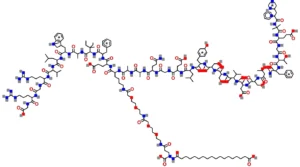
2D chemical structure of GLP-1-S (PubChem CID 56843331), C187H291N45O59, molecular weight 4113.6 g/mol
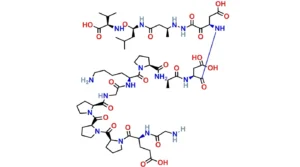
2D chemical structure of BPC-157 (PubChem CID 9941957), C62H98N16O22, molecular weight 1419.6 g/mol
Frequently asked questions
What does this product contain?
Two synthetic peptides, GLP-1-S and BPC-157, supplied together as a lyophilised solid. Exact content and purity for each lot are reported on the certificate of analysis.
Why are both a CAS number and a PubChem CID given?
CAS numbers are registry identifiers, and PubChem CIDs identify the standardised compound record. The numbers shown here are Compound IDs, not Substance IDs, which identify individual depositor submissions rather than a verified structure.
How is the identity of each component confirmed?
Each lot is analysed by mass spectrometry against the theoretical mass of each peptide, with purity assessed by reversed-phase HPLC.
Is the material supplied as a free peptide or as a salt?
Synthetic peptides are commonly isolated as acetate or similar salts. The counter-ion and net peptide content are reported on the certificate of analysis for each lot.
What is the structural basis of GLP-1-S?
It is a modified analogue of the 7–37 fragment of glucagon-like peptide-1, carrying substitutions at positions 8 and 34 and a linker-attached fatty diacid at position 26, as described by Lau et al. (2015).
Is BPC-157 an internationally recognised drug name?
No. It is a common research name rather than an INN, USAN or IUPAC name.
Is this product approved by FDA or any other regulator?
No. It is a research material and not a drug, and it has not been evaluated for safety or efficacy for any use.
Does Avyn Research provide preparation or administration guidance?
No. Avyn Research supplies analytical materials only and does not provide preparation, administration or use guidance of any kind.
Is there published research on this specific combination?
No peer-reviewed study of this combination was identified. The available research concerns each peptide individually.
Can this material be shipped to every country?
No. BPC-157 is a scheduled substance in Australia and is prohibited in competitive sport worldwide. Purchasers are responsible for checking their own local rules before ordering.
For Research Use Only. Not for human or animal use. Not for use in diagnostic procedures.
Every lot released under this product line, newest first. The lot number printed on your vial label resolves to the certificate below — purity, net content, endotoxin, appearance and the number of vials pulled for the conformity panel.
No lots have been published for this product yet.
- CAS number
- Not assigned for this compound
Handling notes
Reconstitution figures for any fill weight and diluent volume can be worked out on the concentration calculator. Solubility and storage data on this page describe laboratory handling of the material only.
This compound is not light-sensitive under normal laboratory lighting. Standard clear containers are acceptable for reconstituted stock.
Sealed storage
- Temperature
- Shelf life
After reconstitution
- Temperature
- Working window
- Light sensitive
- No
In transit
- Note
- Free shipping
- US orders over $200
Related
Studied alongside this compound
-
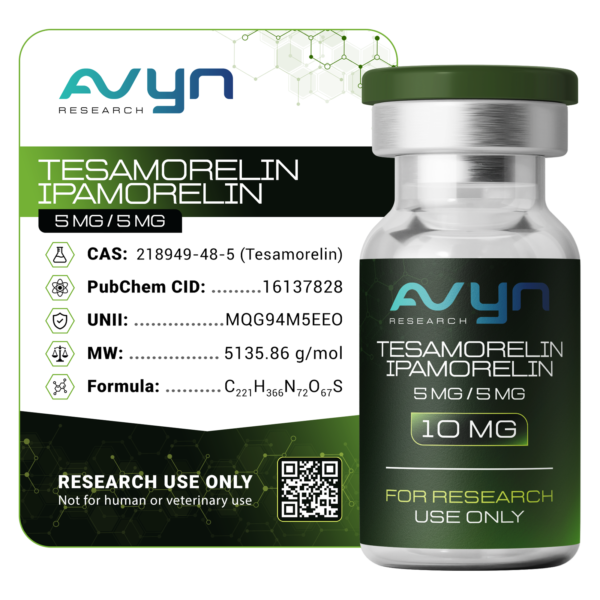
Tesamorelin/Ipamorelin
Tesamorelin and ipamorelin, two separate synthetic peptides supplied for laboratory research. Tesamorelin is a 44-residue analogue of human growth hormone-releasing factor (CAS 218949-48-5). Ipamorelin is a synthetic pentapeptide (CAS 170851-70-4). For research use only.
Add 10mg -
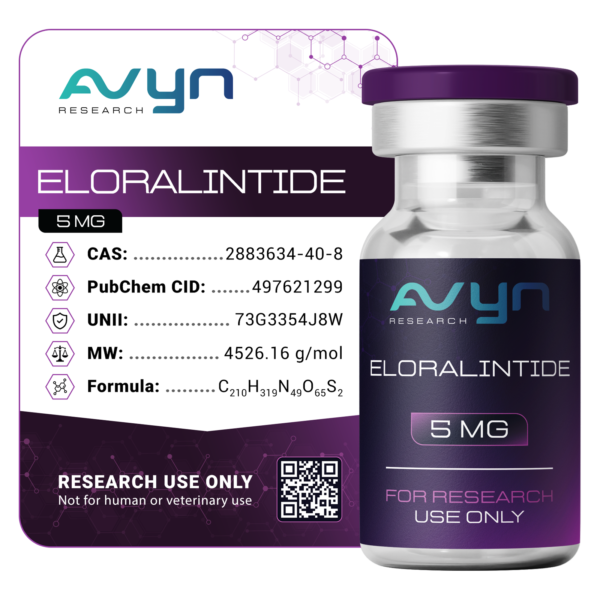
Eloralintide
Eloralintide (LY3841136) is a synthetic 37-residue peptide, listed by the WHO as an amylin analogue, supplied for laboratory research (CAS 2883634-40-8). For research use only.
Add 5mg -
-
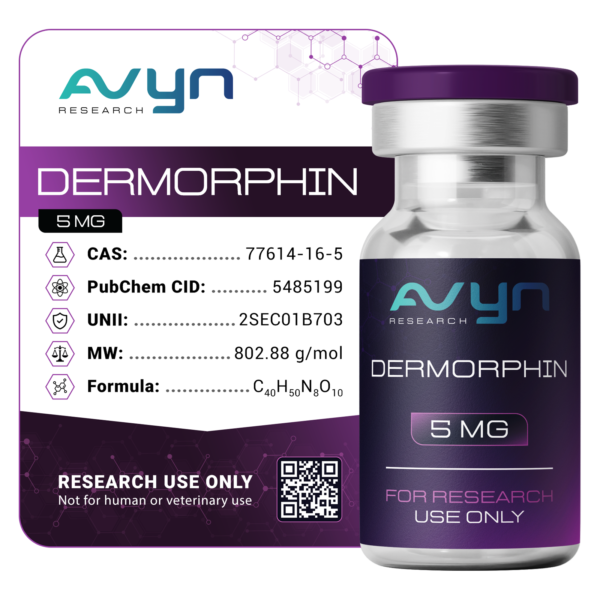
Dermorphin
Dermorphin is a seven-residue opioid peptide with D-alanine at position 2 and an amidated C-terminus.
Add 5mg