Catalogue
Every compound, with the data behind it
60 compounds across 8 categories, with a published certificate for every released lot. Filters are written into the URL, so the view you are looking at is the view you can send to a colleague.
13 compounds
Clear filters-
On sale−25%
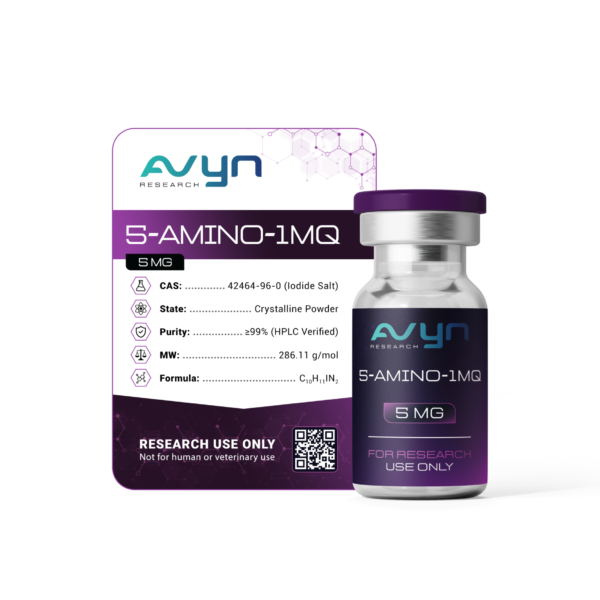
5-AMINO-1MQ
This is a Certified Reference Material (CRM) comprising high-purity 5-Amino-1MQ (5-amino-1-methylquinolinium). Unlike peptide-based incretins, this is a Small Molecule Inhibitor targeting the cytosolic enzyme Nicotinamide N-methyltransferase (NNMT). It is engineered strictly for Cellular Metabolic Profiling, focusing on cellular bioenergetics, NAD+ flux quantification, and satellite cell proliferation in myofiber models. Molecular Identity: Chemical Name : 5-amino-1-methylquinolinium iodide CAS Number : 42464-96-0 (Iodide Salt) Target : NNMT Enzyme (Cytosolic) Mechanism : NAD+ Salvage Pathway Modulation
Add 5mg -
AMY-Cg
AMY-Cg (AM-833; CAS 1393461-38-5) is a synthetic, lipidated long-acting analogue of the pancreatic peptide hormone amylin, engineered for sustained activity at all three amylin receptor subtypes (AMY1R, AMY2R, AMY3R) and the calcitonin receptor (CTR) — classifying it as a dual amylin and calcitonin receptor agonist (DACRA). A C20 fatty diacid N-terminal lipidation strategy enables albumin binding, reducing plasma clearance and extending circulating half-life to approximately 159–195 hours (~7 days) in pharmacokinetic research studies. Targeted structural modifications (14E/17R salt-bridge substitutions; 25P/28P/29P proline substitutions) simultaneously prevent amyloid fibril formation. Cryo-EM structures published in Nature Communications (2025) resolve AMY-Cg bound to Gs-coupled active AMY1R, AMY2R, AMY3R, and CTR at atomic resolution. Preclinical research in RAMP1/3 knockout mouse models confirms that AMY-Cg's metabolic signalling effects are specifically dependent on intact AMY1R and AMY3R function in hindbrain neuronal circuits (area postrema/NTS). FOR RESEARCH USE ONLY. Not for consumption, human or animal administration, or any application outside a controlled non-clinical laboratory setting.
Add 5mg -
On sale−23%
AMY-Cg/GLP-1-Sm
AMY-Cg/GLP-1-Sm is a co-formulation comprising two distinct peptide analogues: GLP-1-Sm and Cagrilintide. This material is supplied strictly for Research Use Only (RUO) and is not intended for human or veterinary use. It is utilized exclusively in laboratory settings for in vitro and in vivo analysis of metabolic pathways. Profound Aminos makes no therapeutic, diagnostic, or medical claims regarding this compound. The product is provided as a lyophilized powder for solution preparation and analytical characterization.
Add 10mg -
ARA-290 10mg
ARA-290 (Cibinetide), also known as pHBSP, is an 11-amino acid synthetic EPO-derived research peptide designed for laboratory investigation of innate repair receptor (IRR) signalling and EPOR/CD131 receptor pharmacology. Its selective non-erythropoietic profile supports tissue-protection and inflammatory pathway research without red blood cell stimulation. Supplied as a lyophilized 10 mg research reagent with COA verification. For laboratory research use only.
Add 10mg -
GLP-1-Sm
GLP-1-Sm is a long-acting GLP-1 receptor agonist derived from human GLP-1 and engineered for extended activity through DPP-4 resistance and albumin binding. Registered as PubChem CID 56843331 (C187H291N45O59; 4113.58 g/mol), it is the active pharmaceutical ingredient in Ozempic, Wegovy, and Rybelsus. This scientific reference resource provides molecular, pharmacological, and 2026 regulatory overview information for academic and professional use.
Add 5mg -
GLP/GIP-Tz
This is a Research Reagent designed strictly for laboratory Stock Solution Preparation, available in multiple mass formats from 5mg to 120mg. It features a lyophilized “cake” of the Dual-Agonist Ligand (GLP/GIP-Tz), allowing researchers to reconstitute a single, uniform batch for longitudinal metabolic studies at the scale their protocol requires. Higher-mass formats eliminate inter-batch variance found in smaller units when large stock volumes are needed. Not for human use.
Add 5mg -
GLP/GIP/GLC-Rt
GLP/GIP/GLC-Rt Research Grade (RUO) (CAS 2381089-83-2, LY3437943) is a 39–amino acid unimolecular peptide designed as a triple agonist for GIP / GLP-1 / Glucagon (GCG) receptors. Supplied as a lyophilized white powder with ≥99% purity (HPLC verified) and endotoxin <1.0 EU/mg, it is soluble in Solution. The molecule includes a C20 fatty diacid moiety for albumin binding and extended stability (reported ~6-day half-life), supporting metabolic, obesity, T2D, and hepatic defatting research models.For Research Use Only (RUO). Not for human or veterinary use.
Add 5mg -
Mazdu
Mazdu (Dual-A) is the high-affinity substrate required for isolating metabolic signaling pathways. Unlike mono-ligands (like GLP-1-Sm [Ref Std]), Mazdu (Dual-A) demonstrates simultaneous binding affinity for both the GLP-1 Receptor and the Glucagon Receptor (GCGR), facilitating complex Ex-vivo Research Protocols.
SKU MAZD-6MG-4183
Add to cart -
PT-141
PT-141, also known as Bremelanotide, is a synthetic cyclic heptapeptide melanocortin receptor agonist developed for laboratory investigation of MC1R, MC3R, MC4R, and MC5R receptor signalling pathways. Derived from melanotan II with a cyclic lactam structure and enhanced stability features, it serves as a research tool for studying central melanocortin pharmacology and neural pathway modulation. Supplied as lyophilized powder with COA verification. For laboratory research use only.
Add 10mg -
Sermorelin
Sermorelin Acetate (GHRH 1-29) is a high-purity (≥99%) synthetic peptide for research. Verified CAS 86168-78-7. The primary compliant GHRH agonist for investigating pituitary pulsatility, sleep architecture, and neuroendocrine function. USA Cold-Chain Stored. Research Use Only (RUO).
Add 5mg -
Survo
Survo (BI 456906; CAS 2805997-46-8; PubChem CID 168429725) is a synthetic, acylated 29-amino-acid research peptide derived from the glucagon backbone, engineered as a dual agonist at glucagon receptors (GCGR) and GLP-1 receptors (GLP-1R). A C18 fatty diacid side chain at position 24, linked via a hydrophilic glycine-serine spacer, enables albumin binding for extended circulating presence and once-weekly research protocol administration. A non-coded amino acid (1-aminocyclobutane-1-carboxylic acid; Ac4c) at position 2 differentiates Survo from native glucagon and enhances receptor selectivity. Developed by Boehringer Ingelheim under licence from Zealand Pharma, Survo is in Phase 3 clinical research programmes (SYNCHRONIZE series for body-weight management; LIVERAGE programme for MASH) and holds FDA Breakthrough Therapy Designation for non-cirrhotic MASH with moderate to advanced fibrosis. It is not approved by the FDA for any indication as of March 2026. FOR RESEARCH USE ONLY. Not for consumption, human or animal administration, or any application outside a controlled non-clinical laboratory setting. Researchers require institutional approval, appropriate biosafety protocols, and batch COA documentation before any laboratory use.
Add 10mg -
TESOFENSINE (Research tablets)
Tesofensine, also known as NS-2330, is a synthetic small-molecule triple monoamine reuptake inhibitor registered under PubChem CID 11370864. It is not a peptide and is distinct from CJC-1295 or ipamorelin. Tesofensine is not FDA-approved as of 2026, while the Tesomet combination remains under regulatory development for specific rare-disease indications.
Add 500 mcg -
VIP
Vasoactive Intestinal Peptide (VIP) - Research Grade (RUO) is a 28-amino acid neuropeptide (glucagon/secretin family) supplied as a lyophilized powder with ≥99% purity (HPLC verified) and ~3326 Da molecular weight. Validated for VPAC1/VPAC2 signaling studies and commonly used in immunology and neuroprotection research (e.g., Treg generation, NLRP3 inflammasome inhibition). COA available, lot-verified via HPLC & MS. Store at −20°C, desiccated; protect from oxidation (Met17 sensitive).For Research Use Only (RUO). Not for human or veterinary use.
Add 10mg
All materials are supplied strictly for laboratory research use only and are not for human or veterinary use of any kind.